
Beyond Decarbonization: Why Energy Resilience Should Become a Core Criterion in Social Impact Assessment
Guest Post by IAIA Member Stanislav Redko
The global energy transition is reshaping the way societies generate, distribute, and consume electricity. Across the world, governments, industries, and communities are accelerating the deployment of renewable energy technologies to reduce greenhouse gas emissions, strengthen energy independence, and support long-term climate objectives.
This transformation represents one of the most significant infrastructure changes of the 21st century. However, as energy systems become increasingly decentralized and dependent on digital technologies, a critical question is emerging: how resilient are these new systems when communities face unexpected disruptions?
Recent years have demonstrated that sustainability cannot be measured only by carbon reductions or renewable energy capacity. Extreme weather events, cyber threats, geopolitical instability, and large-scale grid failures have revealed the vulnerability of energy systems that were not designed for rapidly changing operating conditions.
For impact assessment practitioners, this creates a new challenge. Traditional EIA and SIA approaches have developed strong methodologies for evaluating environmental consequences, stakeholder concerns, and community impacts. Yet the reliability and resilience of energy infrastructure itself has often remained outside the central scope of social assessment.
Electricity reliability directly influences the ability of communities to access essential services, including healthcare, water supply, emergency communication, transportation, and public safety systems. When energy infrastructure fails, the consequences are not only technical—they become social, economic, and humanitarian.
Professional experience in the design and operation of complex power systems demonstrates that energy resilience should be understood as more than an engineering characteristic. The ability of infrastructure to maintain critical functions during periods of disruption represents a measurable contribution to community well-being and adaptive capacity. Microgrids provide an important example of this evolving relationship. Originally developed as a solution for improving operational flexibility and integrating distributed energy resources, they are increasingly recognized as a mechanism for strengthening community resilience. Their value extends beyond technical performance by supporting continuity of essential services when centralized systems experience failures.
Should the resilience of energy infrastructure become a recognized indicator of social impact? The following five observations explain why energy resilience deserves greater attention within impact assessment.
1. Decarbonization Alone Does Not Ensure Resilience
The rapid expansion of renewable energy has fundamentally changed the structure of electricity networks. Solar generation, wind power, battery storage, and distributed energy resources are essential components of global decarbonization strategies. However, the transition toward cleaner energy systems also introduces new technical and governance challenges that must be considered during project evaluation.
Historically, power systems were built around large synchronous generators that provided natural system inertia—the ability to resist sudden changes in frequency and maintain operational stability. Modern renewable energy technologies increasingly rely on inverter-based systems, which require advanced control strategies to provide comparable levels of stability and reliability.
Without appropriate planning, protection systems, energy storage, and intelligent control mechanisms, the integration of renewable generation may create additional operational challenges. These challenges are particularly significant when electricity networks experience extreme conditions or unexpected disturbances.
For impact assessment, this introduces a broader understanding of sustainability. A project that delivers significant emissions reductions may still create unintended risks if it does not adequately address long-term operational resilience.
Energy infrastructure affects communities not only through environmental impacts but also through the availability and continuity of essential services. A prolonged power interruption can disrupt healthcare operations, limit access to clean water, interrupt communication networks, and create additional risks for vulnerable populations.
Therefore, future assessment methodologies should consider a wider range of energy performance indicators. Beyond measuring carbon intensity and renewable generation capacity, assessments should examine whether infrastructure can maintain critical functions during emergencies and adapt to changing conditions.
This approach does not challenge the importance of renewable energy development. Instead, it strengthens the concept of sustainable infrastructure by recognizing that environmental progress and social resilience must advance together.
2. Microgrids Create Social Benefits, Not Just Technical Benefits
Microgrids represent one of the most promising approaches for improving the resilience of modern energy systems. Their ability to operate either connected to the main electricity network or independently during disruptions creates new opportunities for protecting essential services.
However, the significance of microgrids extends beyond their technical architecture. Their greatest contribution lies in the social outcomes they enable.
When a hospital maintains electricity during a regional outage, emergency services remain operational, water infrastructure continues functioning, and communities can preserve access to essential resources, resilience becomes a tangible social benefit. In these situations, engineering performance directly influences public safety, quality of life, and community confidence.
This relationship requires a broader interpretation of infrastructure assessment. Energy reliability should not be considered solely a technical indicator reported by engineers. It should also be evaluated as a factor influencing social vulnerability, adaptive capacity, and community resilience.
A resilient energy system can reduce the consequences of disruptions by enabling faster recovery, protecting critical services, and reducing dependence on centralized infrastructure during emergencies. These benefits are particularly important as climate change increases the frequency and severity of extreme events affecting energy networks.
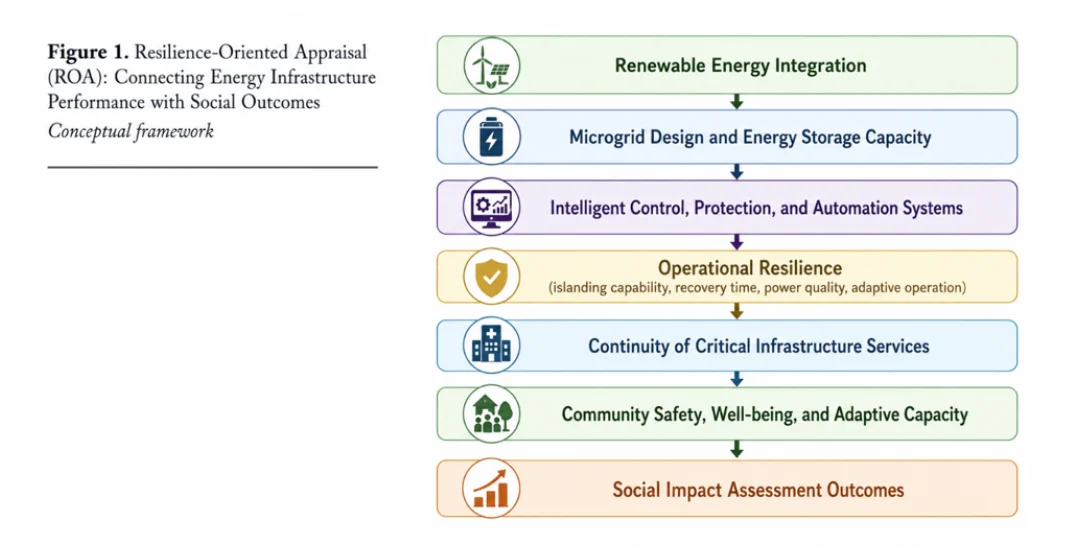
Building on this understanding, the proposed Resilience-Oriented Appraisal (ROA) approach seeks to connect technical resilience parameters with social impact assessment. The framework considers indicators such as autonomous operation capability, recovery time, power quality, and system flexibility as elements that contribute directly to community well-being.
By integrating these dimensions into impact assessment practice, energy projects can be evaluated not only by what they produce, but also by how effectively they support the communities that depend on them.
3. Energy Reliability Is a Social Impact
Electricity reliability has traditionally been treated as an operational parameter measured through engineering indicators such as outage frequency, system stability, and restoration time. However, as societies become increasingly dependent on electricity-driven services, the consequences of energy disruptions extend far beyond technical performance.
For communities, the availability of reliable electricity determines whether essential systems can continue functioning during periods of uncertainty. Healthcare facilities, water infrastructure, emergency communication networks, and public services all depend on stable energy supply. When these systems fail, the resulting impacts are experienced socially rather than only technically.
This connection creates an opportunity to expand the role of SIA. Rather than considering energy reliability as a background condition, assessment methodologies can recognize it as a factor that directly influences community resilience.
The proposed ROA framework addresses this gap by introducing a more integrated perspective. It considers technical characteristics—such as islanding capability, autonomous operating time, dynamic recovery performance, and power quality—as elements that contribute to broader social outcomes.
Such an approach reflects the evolution of impact assessment itself. Modern assessment practice increasingly focuses on complex systems, cumulative effects, vulnerability, and adaptive capacity. Energy infrastructure fits naturally within this broader perspective because failures within power networks can trigger interconnected consequences across multiple sectors.
Integrating resilience indicators into project assessment can also improve decision-making for governments, investors, and communities. Energy projects would be evaluated not only according to their contribution to climate goals, but also according to their ability to maintain essential functions throughout their operational lifecycle.
4. Digital Infrastructure Is Part of Infrastructure Resilience
The resilience of future energy systems will depend not only on the availability of renewable generation and storage capacity, but also on the intelligence of the systems controlling them.
As electricity networks become more decentralized, traditional approaches to protection and management are becoming increasingly insufficient. Distributed energy resources introduce new operational conditions, including bidirectional power flows, variable generation patterns, and lower fault current levels. These changes require adaptive solutions capable of responding dynamically to different system states.
Modern microgrids increasingly rely on advanced automation, digital communication, and intelligent control technologies. Standards such as IEC 61850 provide a foundation for more coordinated and transparent operation of electrical infrastructure, while adaptive protection systems allow networks to respond effectively during both grid-connected and autonomous operation.
From an impact assessment perspective, these technologies should not be viewed only as engineering components. They influence whether infrastructure can continue delivering essential services during emergencies.
For example, an energy system equipped with intelligent protection and automated load management may preserve electricity supply for critical facilities even when overall system capacity is reduced. Similarly, predictive analytics and artificial intelligence can support early detection of abnormal conditions, allowing operators to respond before failures escalate.
However, digital transformation also introduces new challenges. Increased connectivity creates additional cybersecurity requirements, while the growing complexity of energy systems requires stronger cooperation between technology providers, regulators, and infrastructure operators.
For impact assessment practitioners, this means that future evaluations will need to consider not only physical infrastructure but also digital resilience. Cybersecurity strategies, communication standards, operational transparency, and adaptive management capabilities will become increasingly relevant elements of responsible infrastructure planning.
5. Engineering and Impact Assessment Must Work Together
The energy transition demonstrates that technical and social considerations can no longer be separated. Infrastructure decisions that appear successful from an engineering or environmental perspective may produce unintended consequences if broader community impacts are not considered.
Historically, engineers and impact assessment professionals have often approached projects from different perspectives. Engineers have focused on reliability, safety, and operational performance, while impact assessment practitioners have concentrated on environmental effects, stakeholder engagement, and social outcomes.
A resilient energy project is not defined only by the amount of renewable energy it generates or the emissions it avoids. It is also defined by its ability to support communities, protect essential services, and recover from unexpected disruptions.
This integrated approach has implications for policymakers, regulators, and investors. Future energy policies may need to move beyond measuring installed renewable capacity and incorporate indicators related to resilience, flexibility, and operational continuity.
For communities, this shift can also change the way energy projects are understood. Infrastructure that provides visible social benefits—such as maintaining healthcare services during outages or ensuring emergency communication—can strengthen public acceptance and trust.
The next generation of impact assessment methodologies should therefore encourage stronger collaboration between engineering disciplines and social sciences. By combining technical expertise with community-focused evaluation, practitioners can support infrastructure decisions that are both environmentally responsible and socially resilient.
Why This Matters for Impact Assessment
The transformation of energy systems requires impact assessment professionals to expand the way infrastructure risks and benefits are evaluated. Renewable energy projects will continue to play a central role in climate action, but their long-term contribution to sustainable development depends not only on emissions reductions—it also depends on their ability to provide reliable and equitable services under changing conditions.
For practitioners, this creates new opportunities for interdisciplinary collaboration. Assessing modern energy infrastructure increasingly requires dialogue among engineers, social scientists, policymakers, regulators, communities, and technology specialists. Integrating resilience considerations into assessment processes can improve project planning by identifying vulnerabilities earlier, strengthening stakeholder communication, and supporting more informed decisions.
As energy systems become more decentralized, digital, and interconnected, impact assessment has an important role to play in ensuring that the transition toward cleaner energy also supports safer, more adaptable, and more resilient communities. Future methodologies may incorporate standardized resilience indicators, stronger integration of engineering and social assessment, and closer collaboration between infrastructure planners and affected communities.
Ultimately, the challenge is not simply to build cleaner energy systems. It is to create infrastructure that remains dependable, inclusive, and capable of supporting societies when disruptions occur. A sustainable energy future should therefore be measured not only by the carbon emissions it avoids, but also by its ability to protect essential services and strengthen community resilience.
transformation within the IA field. Earlier discussions about improving IA effectiveness often focused on procedural improvements – better participation, more transparent reporting, or stronger scientific analysis.
Today, the focus has shifted toward something more ambitious: ensuring that development decisions are compatible with planetary limits and climate goals.
This transformation also requires new forms of collaboration. Climate impact assessment draws on expertise from environmental science, economics, engineering, social sciences, and public governance. It also requires stronger coordination between regulatory agencies, financial institutions, and civil society.
For IA practitioners, this evolving landscape presents both a challenge and an opportunity. By strengthening climate analysis, impact assessment can play a central role in shaping sustainable development pathways.
Further Reading & Sources
Vanclay, F., Esteves, A. M., Aucamp, I., & Franks, D. M. (2015). Social Impact Assessment: Guidance for Assessing and Managing the Social Impacts of Projects. International Association for Impact Assessment (IAIA).
International Energy Agency (IEA). (2023). Electricity Grids and Secure Energy Transitions. Paris: International Energy Agency.
International Energy Agency (IEA). (2024). Batteries and Secure Energy Transitions. Paris: International Energy Agency.
International Renewable Energy Agency (IRENA). (2023). Renewable Energy and Resilience: Supporting Energy Security Through Distributed Solutions.
International Energy Agency (IEA). (2024). Integrating Solar and Wind: Managing Variability in Power Systems.

Stanislav Redko is Chief Power Engineer at Balex Electrical Company, LLC, specializing in high-voltage power systems, distributed energy resources, microgrid architecture, and resilient energy infrastructure. His professional work focuses on the integration of renewable energy technologies, intelligent protection systems, automation solutions, and advanced approaches to improving the reliability of complex electrical networks. Through practical engineering experience, he explores the relationship between technical resilience and broader sustainability objectives, including community safety, infrastructure continuity, and social impact assessment. His areas of interest include the development of resilience-oriented approaches for evaluating energy projects and strengthening cooperation between engineering disciplines and impact assessment professionals.
Disclaimer: The views expressed in this guest post are those of the author and do not necessarily reflect the views or positions of IAIA.