
London Climate Week: Cooking Systems-Thinking Recipes
What London Climate Week 2026 revealed about systems thinking, climate finance, electrification, and the future of impact assessment. Reflections from IAIA CEO Gary Baker.

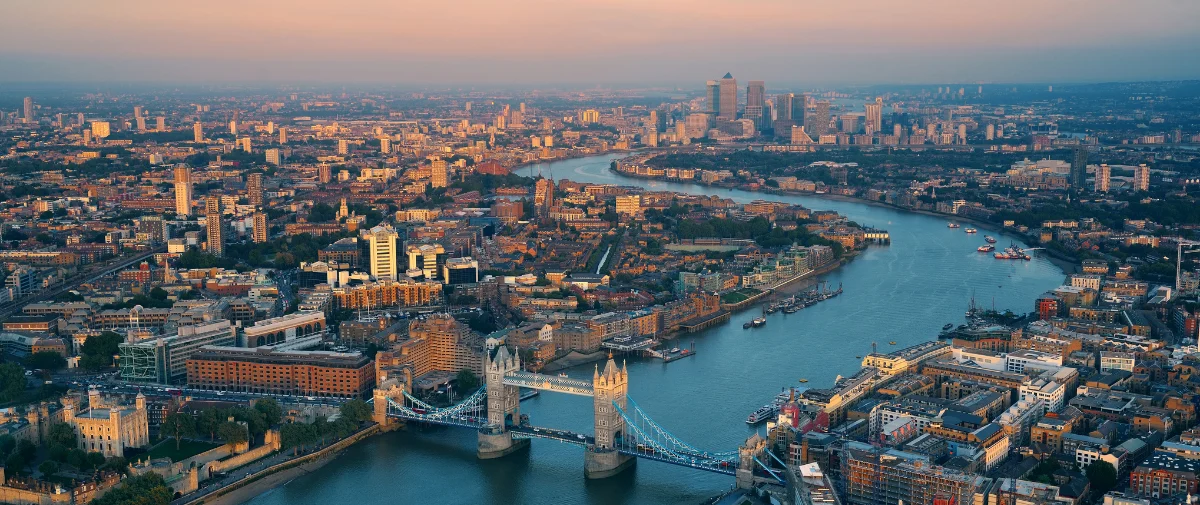
I recently spent time exploring the 2026 London Climate Action Week (LCAW), which ran June 20–28 under a fittingly blunt theme: “Cooperation in a Fractured World.” During the event, England recorded its warmest June on record — a heatwave and resulting Met Office red extreme heat warning that forced the last-minute cancellation of an LSE Grantham Research Institute panel titled, without apparent irony, “Extreme Heat: Improving governance and strengthening action around the world.”
You could not have scripted a starker metaphor for where we find ourselves: the adults are in the room, but the room is on fire.
In trying to extract conclusions from LCAW and link them to impact assessment, I’m drawing on both what I saw in the sessions I attended (which were heavily focused on sustainable finance and climate research) and on write-ups from, and conversations with, other participants. The only certainty when navigating a menu of more than 1,000 events across the week is that there was always another presentation you wished you’d seen.
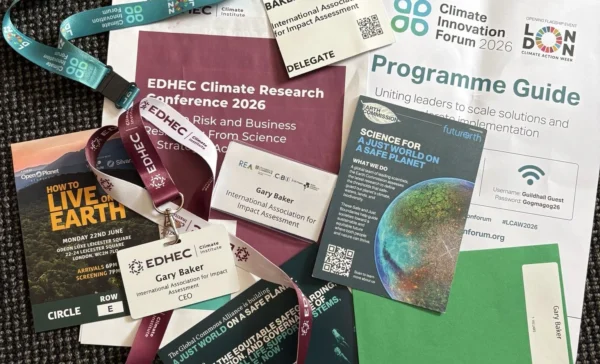
This is the 8th edition of LCAW, and this was evident in the evolution of arguments and discussions, even over the past 12 months. Nobody at this year’s summit was asking whether climate risk matters. They were asking how to price it, route capital around it, and build systems resilient enough to survive being wrong about it sometimes.
That’s much more a systems-thinking problem than an advocacy problem, which should be good news, since it’s exactly the kind of problem the impact assessment profession should be equipped to handle. The uncomfortable question LCAW left me with is whether the discipline can adapt to solve it, or whether it’s still mostly producing somewhat siloed technical documents mitigated by a longer stakeholder-engagement chapter.
Four data points worth paying attention to
Four reports and launches during the week sharpen that question.
- WBCSD’s Business Breakthrough Barometer 2026
Drawing on more than 500 senior business leaders across over 50 economies, collectively representing over $2 trillion in revenue, this report from the World Business Council for Sustainable Development (WBCSD) found that 92% of leaders now see sustainability as a source of competitive advantage, and 89% maintained or grew investment over the past year.
OK, but that’s not new.
What’s new is that 68% of those same leaders now see a disorderly transition as more likely than they did a year ago, and 40% say it would significantly disrupt their operations. That anxiety is, at bottom, a systems-thinking failure being re-priced in real time. Businesses that assessed policy risk, supply-chain risk, and physical risk as separate line items are now bracing for compounding effects being modelled as one system.
- UNEP Finance Initiative Risk Centre
The Landscape of Sustainability Risk Integration report made the structural shift explicit: sustainability risk should be treated as a cross-cutting driver of standard prudential risk categories — credit, market, liquidity, operational, and reputational — rather than a bolt-on ESG category.
71% of banks consulted have already built a sustainability risk integration framework, with another quarter planning to. That’s the discipline being absorbed into the core machinery of finance, which is exactly where complex systems thinking needs to live. Credit risk, grid capacity, water stress, and supply chain exposure don’t sit in separate silos in the real economy, and pretending they do is how institutions get surprised.
- Cambridge Institute for Sustainability Leadership’s Insurability Readiness Matrix
Arguably the most concrete systems-thinking artefact of the whole week was the launch, through CISL’s ClimateWise network, of the Insurability Readiness Matrix. It is a shared diagnostic that scores an asset or region’s insurability across seven components, each rated red, amber, or green with a trend signal and a pathway to improvement.
The logic is straightforward. Uninsurability isn’t a side effect of climate change, but rather a leading indicator of it. Once an asset or region tips into it, the consequences cascade: insurance retreat, credit contraction, investment flight.
CISL puts 2024’s global insurance protection gap at US$318 billion, with more than half of catastrophe losses left uninsured. That gap is split between emerging markets that never had meaningful penetration to begin with (Pakistan’s 2022 floods caused US$15.2 billion in losses with catastrophically low coverage) and advanced economies where insurers are now actively withdrawing (California’s state-backed insurer of last resort has seen its exposure more than triple since 2022, to US$724 billion).
Insurance strain risk is well-recognized. What the Matrix provides is a co-designed, common language, built because insurers, financiers, developers, and policymakers were assessing physical resilience, financial capacity, and community readiness as separate problems and struggled to act coherently as a result. In sharp contrast to other data points here, the Matrix is explicitly built to inform decisions before they’re made, not to report on their consequences afterwards.
- GRI’s global reporting analysis
A new analysis from the Global Reporting Initiative (GRI), drawing on published reports from nearly 15,000 listed companies across 132 jurisdictions, found that sustainability reporting is both alive and well, but that reporting leadership is shifting toward Asia and Latin America. These regions are now advancing faster than mature markets in Europe and North America.
The centre of gravity for rigorous, impact-focused disclosure is moving south, away from Brussels and Washington. Some of that is catch-up. Some of it looks like economies building disclosure practice free from the baggage of (Northern) institutional legacy to unwind first — the same pattern seen below with electrification.
Much of this speaks to disclosure — outputs, as it were — with one real exception. The Insurability Matrix is trying to do something different in kind: score forward-looking risk before the financing decision gets made, not report on impact after the fact. That’s closer to what impact assessment is actually for.
But the wider read-across still holds. The businesses and institutions we face off against are adapting both thinking and practice, whereas the IA profession itself is, arguably, still assessing climate, nature, and social impact as separate technical exercises that meet for the first time, if at all, in the final report.
Uninsurability isn't a side effect of climate change, but rather a leading indicator of it.
The tension wasn't simply heat-induced
At the LCAW launch event I attended, the collective nervousness of a sustainability audience was evident, given the geopolitical pushback that has been building over the past 12 months. There was an almost ritualistic opening line from every presenter that this is just “a short-term cyclical downturn, but the long-term trend is still intact.” It was said with enough repetition, by enough different speakers, that it stopped sounding like analysis and started sounding like something closer to liturgy.
Three real tensions were on full display in London, and each one is a systems-thinking failure at a different scale.
- Cooperation-without-consensus might just be fragmentation with better branding. LCAW founder Nick Mabey put the optimistic case plainly: you don’t need consensus to get things done, because different coalitions are moving different pieces forward. It wasn’t totally convincing, and maybe the absence of shared rules is exactly what’s driving the disorderly-transition anxiety businesses flagged in the Barometer. Coalitions of the willing represent real progress until the coalitions start contradicting each other on carbon border rules, subsidy design, or grid standards — at which point fragmentation becomes a real cost landing on the same companies cheering flexibility today. Both things can be true, but maybe the clearest test case of exactly this tension playing out is at COP31 in Antalya this November, with its “unique” co-hosting structure (worthy of a blog post in its own right).
- Adaptation finance is still stuck where mitigation finance was a decade ago. The Global Goal on Adaptation remained in technical deadlock during the Bonn talks that preceded London. Developing nations used LCAW to argue, again, for adaptation support that has been promised repeatedly but delivered unevenly, at best. IIED summarised the situation well, stating that gender-just, locally-led solutions aren’t a nice-to-have add-on but the most effective response available — precisely because the alternative, top-down finance architecture keeps failing to reach the people most exposed. (To be fair, GFANZ did release a useful report on private sector cases studies in adaptation finance).
Information integrity is now formal climate governance, and the scale of the problem is bigger than most organisations realise. Information integrity was written into the COP Action Agenda for the first time at COP30 in Belém last year, a recognition that disinformation is a governance risk in its own right.
Perhaps prompted by our very own IAIA26 conference theme in Québec, C40 announced the launch of City Climate Facts at the conference, with London Mayor Sadiq Khan citing polling that found 84% of Londoners say they regularly encounter climate information they believe may be false or misleading, while three-quarters say disinformation and misinformation pose a serious risk to their community. However it spreads, the scale of public exposure to “bad” information is now a measured, reported number, not an assumption. That capacity gap is the same test impact assessment now faces, as flagged in Québec: can rigorously produced information still be trusted and heard when it’s drowning in synthetic and contested alternatives that, on first blush, look just as credible?
Electricity is the story — and it's the clearest systems-thinking case study of the year
If I had to pick one theme that dominated London, it was electrification, and the numbers behind it are genuinely striking. Electricity currently meets roughly 21% of global final energy demand. The newly launched “Electrify Now” movement — 40 business groups, think tanks and civil society organisations, backed by governments including the European Commission, Brazil, Türkiye, Australia, Ethiopia, Canada, the Philippines, South Korea, and the UK, along with the IEA and IRENA — has set a target of 35% by 2035 (adopted as a key agenda priority by the incoming COP31 Presidency), a pace 4x faster than today’s trajectory.
Energy think tank Ember reported a genuine milestone ahead of the week: in April 2026, wind and solar generated more electricity globally than gas for the first time over a full month on record — 531 terawatt-hours, or 22% of global generation against gas’s 20%. [There is a great slide deck on Asian Electrification from Ember that I will post on the Hub, the networking community for IAIA members.]
Here’s why this matters for the Global South specifically, and why it felt like the most optimistic story hiding amongst the headlines from the whole week. The industrialized North built its prosperity on a sequence: wood, coal, then oil and gas, then decades later, a slow and expensive retrofit toward clean power, layered on top of infrastructure already built and already sunk-cost. [More and More and More by Jean-Baptiste Fressoz provides a great account of the layering of energy systems, rather than the mainstream label of “energy transition.”]
That layering sequence produced siloed institutions to match it — separate ministries, separate financing tracks, and separate assessment traditions for energy, land, water, and social impact — because the technologies arrived one at a time and were assessed one at a time. It was never a law of physics. It was a historical accident of what was available. But emerging economies building out grid capacity now don’t have to repeat it. They can build the electric and renewable base first and increasingly don’t have to inherit the baggage of institutional silos.
The economics increasingly support exactly that. As Luke Menzel, CEO of Australia’s Energy Efficiency Council, put it, electrification is on average three times more energy efficient than combustion-based energy — a number that only really makes sense once you stop treating energy, emissions, land use, and growth as four separate questions and start treating them as one system with one lever. The Electrify Now movement has explicitly built its investment-mobilisation strategy around emerging and developing economies, not as an afterthought but as the primary target. The recent India-UK trade agreement and the India-EU trade negotiations were both cited at LCAW as opportunities to build clean-tech manufacturing and investment cooperation directly into supply chains that are still being designed, rather than retrofitted into ones that already exist.
Put together with the GRI finding on disclosure leadership, a pattern emerges: several Global South economies may be positioned to leapfrog not just the fossil-fuel-first growth model, but the fossil-fuel-first “reporting and measurement” model, too — building impact assessment and clean electrification into growth from day one rather than bolting both on after the fact. That is not guaranteed. It depends entirely on whether the grid, the finance, and the trade architecture actually develop at the pace promised. But the direction of travel is real, and it’s a working demonstration of the shift that impact assessment as a discipline still needs to make.
Three off-grid things to watch
These are the signals from London that didn’t necessarily make the main headlines but provide interesting trends to watch.
- The grid, not capital or technology, is now the constraint. Multiple participants at the Global Energy Transition and Electrification Summit converged on the same diagnosis: clean generation technology is advancing fast and capital is available for viable projects, but power networks haven’t kept pace. Renewable generation can sit stranded while consumers still face unreliable or expensive electricity. That’s what happens when generation, storage, and grid planning get assessed and financed as separate workstreams instead of one system.
- Business is now moving ahead of government mandate, not behind it. A global survey of nearly 2,000 business executives across 18 countries, published by Public First for E3G, the We Mean Business Coalition, and the Global Renewables Alliance, found that 90% expect their operations to be largely electrified by 2035 — but 72% say government policy is moving too slowly to support the pace business itself wants to move at. If that relationship has genuinely inverted (or is it just a familiar business gripe?), the binding constraint on delivery is shifting from corporate will to public infrastructure and permitting. Is that sufficiently captured in current impact assessment mandates and practice?
Businesses in emerging economies now want renewables more than businesses in rich ones do. The same Public First survey found that 86% of business leaders in emerging economies say they want their country powered mainly by renewables-based electricity — above the 82% global average and ahead of the US (77%), UK (76%), Australia (75%), Germany (73%), and Japan (69%). That upends most transition narratives, which still treat the Global South as the reluctant follower waiting on Northern capital and technology. On this data, it’s advanced economies, weighed down by existing fossil infrastructure and existing institutional silos, that are the more reluctant movers.
The takeaway
Sorting through what actually happened in London, a pattern is revealed. The actors moving fastest and most effectively were the ones who stopped assessing components separately. Banks stopped treating sustainability risk as a side category and folded it into the same models they use for credit and liquidity. Businesses stopped waiting for policy certainty and started pricing disorderly-transition risk directly into how they invest. Insurers and financiers built a shared diagnostic that treats physical resilience, financial capacity, and community readiness as one interacting system. And the clearest case of all: economies without a legacy fossil grid to unwind are building electricity systems, financing structures, and disclosure practices together from day one rather than assessing each in its own lane and reconciling them later, if at all.
That’s the challenge sitting in front of impact assessment: how to build one assessment practice that treats climate, nature, social, and financial consequences as interacting variables from the outset — commissioned and read before the financing or consent decision is made, not produced afterwards to justify it. The Insurability Readiness Matrix is an indication that this can be done, and done quickly, once the incentive to act as a system is clear enough. Impact assessment has exactly that incentive sitting in front of it. It’s time to build our own version.
The optimistic case is worth stating plainly, too, because it’s real. Nobody else at LCAW is positioned to do what a genuinely systems-literate impact assessment discipline could do: model how a grid bottleneck, a financing gap, a land-use decision, and a community’s trust in the process actually interact, before the money moves rather than after. That’s not a smaller job than producing better reports. It’s a bigger one, and one that gets harder to commoditise the moment AI can already produce the componentised version faster and cheaper than we can. Judgement across an interacting system, delivered early enough to change the decision, is the one thing that doesn’t get automated away. Adapt at that pace, and impact assessment stops being the discipline that documents outcomes after the fact and becomes the discipline that shapes which outcomes are possible in the first place. This week gave us proof the tool can be built fast once we decide to build it. The only open question is whether we move at the pace the moment demands.
Nobody else at LCAW is positioned to do what a genuinely systems-literate impact assessment discipline could do: model how a grid bottleneck, a financing gap, a land-use decision, and a community's trust in the process actually interact, before the money moves rather than after.