Climate Change Impact Assessment: Five Insights for the Future of Impact Assessment
Guest Post by IAIA Member Andreea Nita
Climate change has transformed the landscape of impact assessment (IA). What was once treated as a single environmental factor – often summarized in greenhouse gas inventories or energy-efficiency discussions – has now become a central organizing principle shaping how projects, policies, and development pathways are evaluated. Since the adoption of the Paris Agreement in 2015, governments and institutions around the world have been required to integrate climate mitigation and adaptation into decision-making. Impact assessment has increasingly become one of the primary tools for operationalizing these commitments.
In response, a growing body of research and practice has focused on Climate Change Impact Assessment (CCIA) – an integrative approach that connects mitigation, adaptation, resilience, and justice considerations within existing assessment frameworks. A recent state-of-the-art review synthesizes the evolution of CCIA across scientific research, policy frameworks, institutional practice, and professional guidance.
The review highlights a clear conclusion: climate change is no longer peripheral to impact assessment. It is redefining the purpose, scope, and influence of the field. Below are five key insights for practitioners and policymakers working at the intersection of climate governance and impact assessment.
Climate change is no longer peripheral to impact assessment. It is redefining the purpose, scope, and influence of the field.
1. Climate change has shifted IA from environmental review to climate governance
Traditionally, IA was designed primarily to evaluate environmental consequences of projects or plans. Climate change has expanded this role significantly.
Today, CCIA assesses not only environmental impacts but also compatibility with long-term climate goals, including emissions pathways, resilience to climate hazards, and alignment with national or global climate commitments.
This shift reflects broader changes in governance. Scientific knowledge (such as carbon budgets), international agreements (such as the Paris Agreement), and economic instruments (such as carbon pricing and sustainable finance frameworks) now interact with IA processes.
As a result, impact assessment increasingly functions as a bridge between climate science, policy implementation, and investment decision-making.
2. Climate impact assessment is becoming institutionalized in law and policy
One of the most significant developments in the past decade is the growing legal integration of climate considerations into impact assessment systems.
Several jurisdictions now require explicit climate analysis within Environmental Impact Assessment (EIA) or Strategic Environmental Assessment (SEA). Examples include European Union legislation, Canada’s Impact Assessment Act, and emerging climate guidance in multiple national regulatory systems.
These legal developments strengthen the role of IA by making climate considerations more consistent, transparent, and enforceable. However, implementation remains uneven. Many countries still rely on voluntary guidance or ad hoc methodologies, highlighting the need for clearer regulatory frameworks and international good-practice standards.
3. Methods are evolving - but standardization remains a challenge
The methodological toolkit for CCIA has expanded significantly. Practitioners increasingly use approaches such as: climate scenario analysis, cumulative greenhouse gas accounting, vulnerability and resilience assessments, life-cycle emissions analysis or climate risk screening. These methods allow assessments to move beyond simple emissions estimates toward systemic evaluation of climate risks and opportunities.
Despite these advances, methodological consistency remains a major challenge. Questions such as how to address cumulative climate impacts, or uncertainty in climate projections are still debated across jurisdictions and sectors. Developing shared methodological frameworks will be essential for improving comparability and credibility in CCIA practice.
4. Climate impact assessment is increasingly linked to sustainable finance
A striking development in recent years is the growing connection between impact assessment and financial decision-making.
Frameworks such as the EU Taxonomy for sustainable activities require evidence that projects contribute to climate mitigation or adaptation and do not cause significant harm to environmental objectives. This effectively transforms impact assessment outputs – such as emissions trajectories or climate risk analyses – into financial disclosure and investment screening tools.
This linkage has important implications. Impact assessments are no longer only regulatory documents. They increasingly provide decision-grade evidence for investors, regulators, and financial institutions seeking to align infrastructure investments with climate goals.
5. The next decade will determine whether CCIA delivers real climate outcomes
Despite substantial progress, climate impact assessment faces several persistent challenges. Implementation gaps remain common, with many assessments still relying on qualitative analyses rather than robust quantitative metrics. Institutional fragmentation between environmental, planning, and energy authorities can also limit the influence of assessment findings on final decisions.
At the same time, emerging opportunities could significantly strengthen CCIA practice.
These include:
- legally binding climate thresholds and “climate tests” for projects
- improved integration of adaptation and resilience analysis
- the use of digital tools, remote sensing, and artificial intelligence
- stronger connections between assessment results, monitoring, and compliance.
The challenge for the next decade will be to move from procedural climate analysis toward measurable climate performance.
Impact assessment increasingly functions as a bridge between climate science, policy implementation, and investment decision-making.
Why this matters for impact assessment practitioners
The rise of climate change impact assessment represents a deeper transformation within the IA field. Earlier discussions about improving IA effectiveness often focused on procedural improvements – better participation, more transparent reporting, or stronger scientific analysis.
Today, the focus has shifted toward something more ambitious: ensuring that development decisions are compatible with planetary limits and climate goals.
This transformation also requires new forms of collaboration. Climate impact assessment draws on expertise from environmental science, economics, engineering, social sciences, and public governance. It also requires stronger coordination between regulatory agencies, financial institutions, and civil society.
For IA practitioners, this evolving landscape presents both a challenge and an opportunity. By strengthening climate analysis, impact assessment can play a central role in shaping sustainable development pathways.
Looking ahead
Over the past two decades, climate considerations have moved from the margins of impact assessment to its core. Climate Change Impact Assessment now represents an integrative practice connecting mitigation, adaptation, justice, and financial governance.
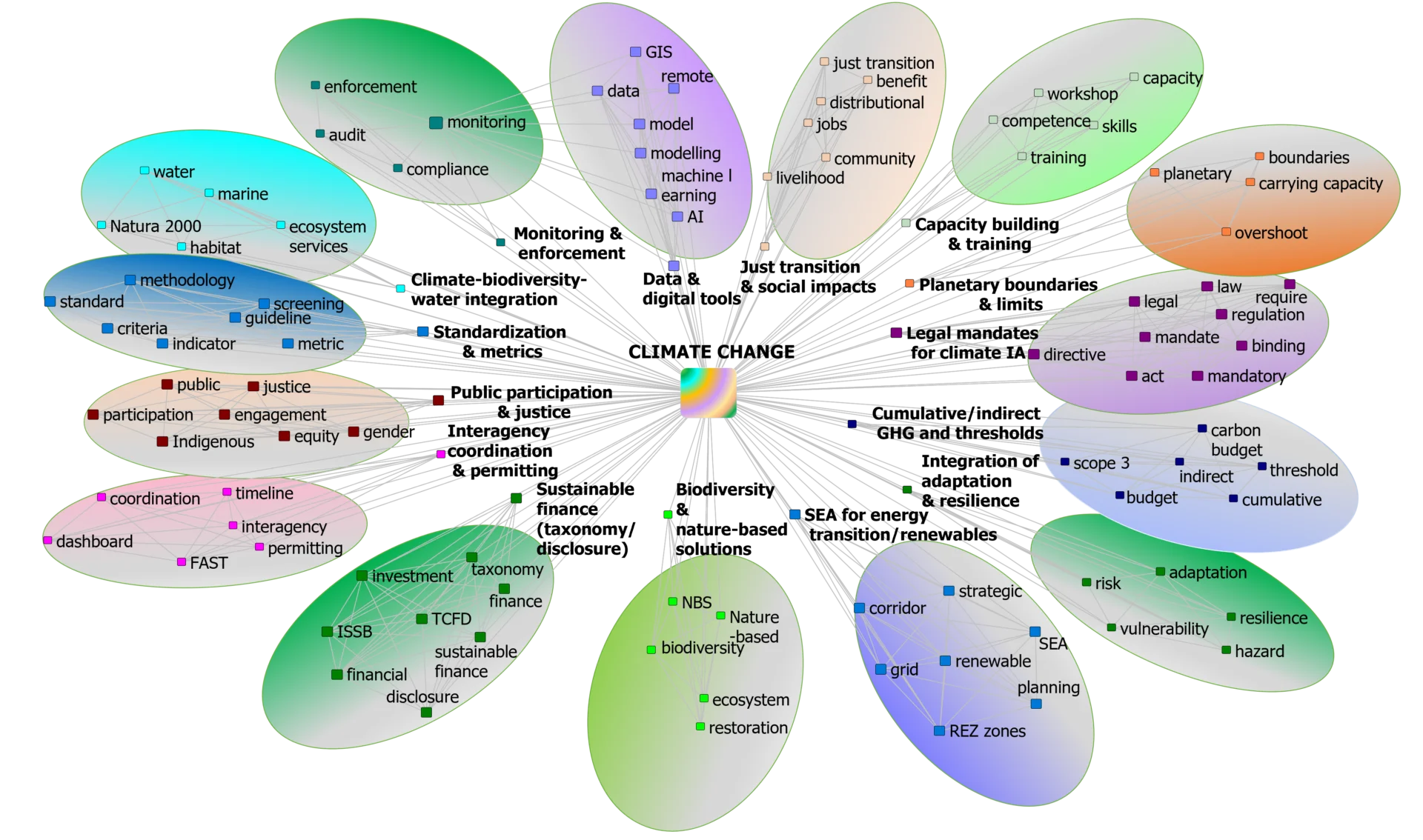
Figure 1. Emerging priorities for Climate Change Impact Assessment (CCIA) identified through a thematic network analysis of practitioner survey responses and literature synthesis. Nodes represent key themes (e.g., legal mandates, sustainable finance, adaptation and resilience, data and AI, and participation and justice), while links indicate how these priorities co-occur across practitioner inputs. The visualization highlights the interconnected pathways through which CCIA can strengthen impact assessment practice, from regulatory frameworks and methodological standardization to capacity building and digital innovation. Source: adapted from Nita et al. (2026), Climate change impact assessment: the state of the art, Impact Assessment and Project Appraisal.
As climate risks intensify and global decarbonization accelerates, the ability of IA systems to incorporate robust climate analysis will become increasingly important. Strengthening legal mandates, harmonizing methodologies, expanding professional capacity, and improving transparency will all be essential steps in ensuring that impact assessment contributes meaningfully to climate action.
Further reading
📖 Check out the full IAPA journal article that inspired this post: Andreea Nita, Stacey Fineran, Weston Fisher, Montserrat Zamorano, and Laurentiu Rozylowicz.(2026). Climate change impact assessment: the state of the art. Impact Assessment and Project Appraisal, 1–12.
🔍 Additional references:
Nita, A., Toro, M. Z., Rozylowicz, L. (2026). Improving Environmental Policies and Impact Assessments through Network Analysis for Accelerated SDG 13 – Climate Action. IOP Conference Series: Earth and Environmental Science, 1582(1), 012023.
Nita, A., Zamorano, M., 2026. NetDeal: Streamlining Environmental Impact Assessment complex networks to integrate new EU environmental policies. Research Ideas and Outcomes 12.
Nita A., Zamorano M., Caro-González A.L., Rozylowicz L. (2025). Driving climate action: brokers as catalysts in EU policy networks. Applied Network Science, 10(1):41.
Nita, A., Zamorano, M., Rozylowicz, L., 2025. Exploring legal frameworks for climate action: a network analysis of Green Deal, EU Directives, and environmental assessment indicators. Journal of Physics: Conference Series 3140, 162005.
Acknowledgment
Funded by the European Union. Views and opinions expressed are, however, those of the authors only and do not necessarily reflect those of the European Union. Neither the European Union nor the granting authority can be held responsible for them.
We acknowledge the financial support of the Marie Skłodowska-Curie Actions (MSCA) Individual Fellowship under grant agreement No. 101152528.

Andreea Nita is a Marie Skłodowska-Curie Actions (MSCA) Postdoctoral Fellow and researcher in environmental assessment and sustainability science, with appointments at the University of Granada. Her work focuses on climate change impact assessment, environmental governance, and the integration of biodiversity, justice, and climate considerations in impact assessment and planning. She serves as Lead Chair of the Climate Change Section of the International Association for Impact Assessment (IAIA) and as Lead Focal Point for Eastern Europe of the IUCN Commission on Ecosystem Management, contributing to international policy, professional guidance, and capacity-building initiatives.