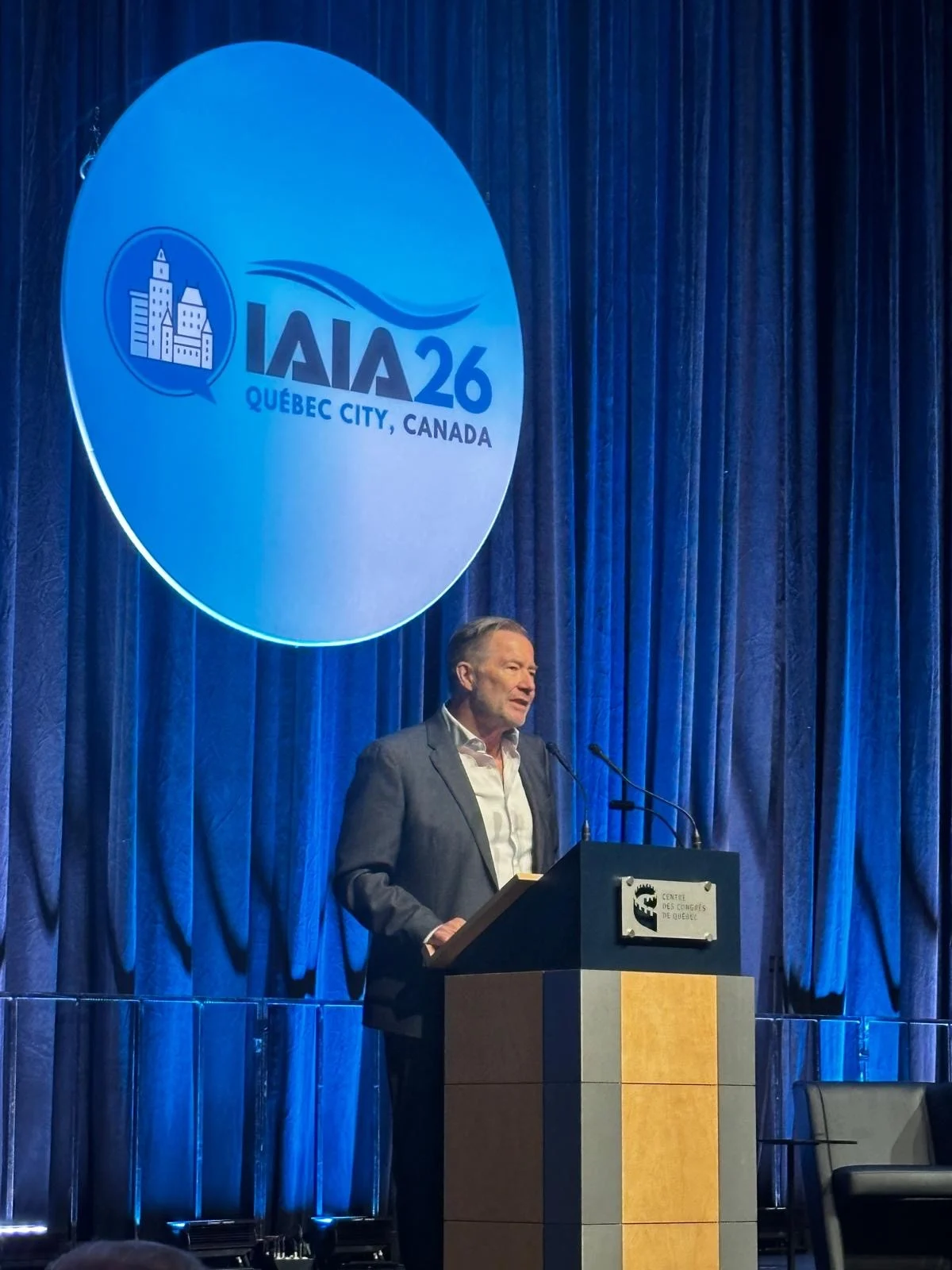
IAIA26: From Information to Influence
IAIA CEO Gary Baker reflects on the key takeaways from IAIA26

At IAIA26, our conference theme was Misinformation, Disinformation, Communication, & Impact Assessment. It was timely and inspired a lot of great presentations and reaction. But after reading through 90 summaries submitted by session chairs, I think the emerging subtext of IAIA26 may not be about misinformation alone. It may be that misinformation is rarely the root problem.
Across multiple sessions, sectors, and disciplines, consistent messages emerged: misinformation tends to flourish where trust is weak, governance is fragmented, participation is late, communication is poor, roles are unclear, and communities feel excluded from decisions that affect them.
In other words, misinformation is often a symptom but the underlying condition might be more accurately defined as a deficit of legitimacy.
That is certainly a more challenging conclusion for our profession, but, potentially, also a more useful one. It suggests that impact assessment cannot respond to today’s information environment simply by producing more information, ‘better’ reports, or more polished communication. What we need to confront is a harder question:
Are we building processes that people can trust?
To explore that question, what follows are ten themes and takeaways from IAIA26, as well as practical implications for both practitioners and policymakers, and closing with some thoughts on the future direction for impact assessment.
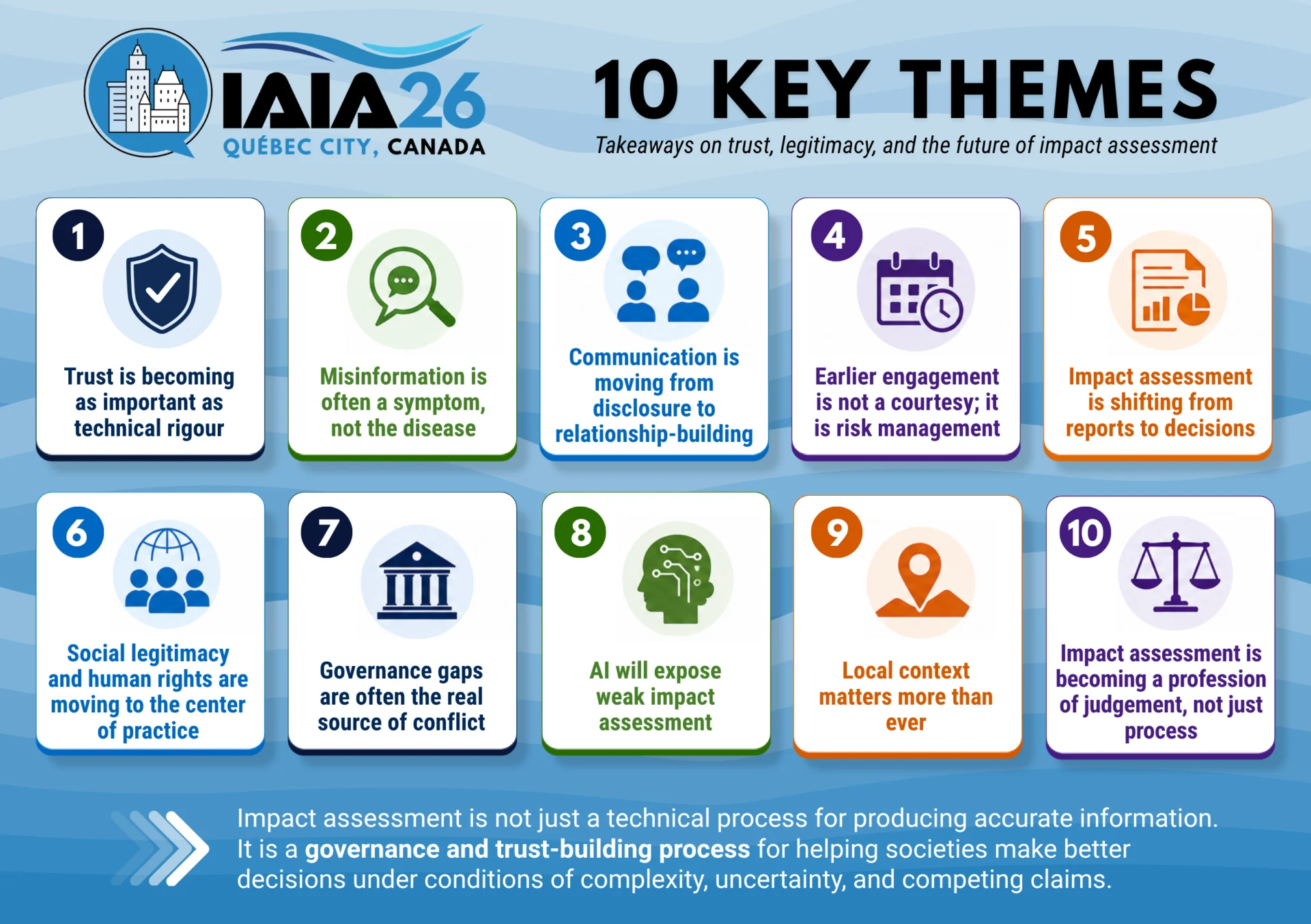
Ten themes from IAIA26
- Trust is becoming as important as technical rigour.
For years, impact assessment has strengthened its credibility through better methods, clearer standards, and deeper technical expertise. All of that still matters (indeed, it is vital). But IAIA26 made clear that technical rigour alone is no longer enough.
We heard that:
- Technically excellent studies can still fail if stakeholders don’t trust the process.
- Evidence is more likely to be accepted when the process producing it is transparent, inclusive, and responsive.
- Trust cannot simply be added at the end of an assessment like seasoning a dish; it has to be built from the beginning.
- In contested settings, true legitimacy may determine whether technical evidence is heard at all.
>> The takeaway: Impact assessment must be rigorous, but it must also be trusted.
- Misinformation is often a symptom, not the disease.
One of the most important insights from the conference was that misinformation rarely appears in a vacuum. It tends to grow in the spaces left by weak governance, poor transparency, late engagement, or exclusion from decision-making.
We heard that:
- Where information is absent, rumour fills the space.
- Where governance is fragmented, alternative narratives flourish.
- Where communities feel excluded, mistrust breeds misinformation.
- Fact-checking matters, but it is not enough if the underlying process lacks legitimacy.
>> The takeaway: We should not only fight misinformation; we should address the conditions that allow it to emerge.
- Communication is moving from disclosure to relationship-building.
Communication in impact assessment has often been treated as a final-stage activity: the report, executive summary, non-technical appendix. IAIA26 challenged that:
We heard that:
- Communication is not simply the transfer of information.
- Listening is as important as explaining.
- Cultural appropriateness, language, accessibility, and timing matter.
- Communication should test assumptions, surface concerns, and build relationships.
- If insights are not understood, trusted, or used, they do not influence outcomes.
>> The takeaway: Communication is not the output of impact assessment; it is central to its effectiveness.
- Earlier engagement is not a courtesy; it is risk management.
Across many sessions, one of the strongest recommendations was the need for earlier and more continuous engagement. The message was remarkably consistent: involve people before project design is locked in, before positions harden, and before mistrust becomes embedded.
We heard that:
- Engagement should begin during screening and scoping, not after key decisions have been made.
- Early engagement helps identify material issues, local knowledge, cumulative effects, and social risks.
- Continuous engagement reduces conflict and improves project design.
- “Slow down to speed up” may be one of the most practical lessons from IAIA26 (for both project proponents and governments).
>> The takeaway: Meaningful participation must begin earlier and continue longer.
- Impact assessment is shifting from reports to decisions.
Several sessions called for a move away from comprehensive documentation for its own (legalistic?) sake and toward more issue-based, decision-focused assessment – a potentially profound shift.
We heard that:
- More data does not automatically mean better judgement.
- Longer reports do not necessarily lead to better decisions.
- The best assessments help people understand what matters most.
- Practitioners need to distinguish signal from noise.
- Issue-based assessment may become increasingly important as information overload grows.
>> The takeaway: Impact assessment must move from documenting impacts to shaping decisions.
- Social legitimacy and human rights are moving to the center of practice.
IAIA26 showed the growing importance of social impact, human rights, equity, cultural heritage, Indigenous knowledge, community wellbeing, and stakeholder safety. These are not peripheral issues. They are increasingly central to a credible assessment.
We heard that:
- Social impacts deserve the same focus and rigour as environmental impacts.
- Human rights, equity, access to information, and fair benefit-sharing need to be integrated throughout assessment processes.
- Indigenous and local knowledge are essential to understanding context.
- Stakeholder safety matters: if people are afraid to speak, the information base is incomplete.
- Participation must be treated as an ongoing relationship, not a procedural step.
>> The takeaway: Impact assessment is becoming a practice of social legitimacy as much as technical analysis.
- Governance gaps are often the real source of conflict.
Many sessions suggested that social conflict is often caused not by the absence of impact assessment, but by weak governance around it: fragmented institutions, unclear responsibilities, poor coordination, and disconnects between formal processes and community expectations.
We heard that:
- Project-level assessment cannot compensate for every failure of planning or governance.
- Cumulative effects require coordination beyond individual projects.
- Regional and strategic assessment are increasingly important.
- Policymakers need to clarify roles, strengthen access to information, and support safe participation.
- Better governance reduces the space in which mistrust & misinformation grow.
>> The takeaway: Impact assessment is increasingly a participatory, governance platform, not just a regulatory procedure.
- AI will expose weak impact assessment.
Perhaps refreshingly AI was not the dominant theme of IAIA26, but it was an important seam running through many discussions. The message was balanced, and perhaps predictable that: AI offers real opportunities, but also serious risks.
We heard that:
- AI can support analysis, translation, accessibility, scenario development, document review, geospatial interpretation, and communication.
- AI also brings risks: hallucinations, bias, poor data quality, false confidence, loss of context, and opaque methods.
- Human oversight remains essential.
- The future practitioner will need to know when to use AI, when not to use it, and how to explain its limits.
- AI should strengthen professional judgement, not replace it.
>> The takeaway: AI does not replace impact assessment; it exposes weak impact assessment.
- Local context matters more than ever.
A recurring message across sessions was the danger of assessments becoming detached from lived experience. Desk-based analysis and digital tools can be powerful, but they cannot substitute for understanding place, culture, power, and community priorities.
We heard that:
- Local and Indigenous knowledge are essential sources of evidence.
- Field verification matters.
- Context determines how impacts are experienced and understood.
- Power dynamics influence who speaks, who is heard, and whose knowledge counts.
- Technical analysis must be grounded in lived reality.
>> The takeaway: Good assessment requires humility as well as expertise.
- Impact assessment is becoming a profession of judgement, not just process.
Taken together, the session summaries suggest a quiet but significant shift in the identity of the profession.
Impact assessment is moving:
- from compliance to governance;
- from consultation to collaboration;
- from project-level thinking to systems thinking;
- from expert-driven assessment to more participatory approaches;
- from static reports to adaptive tools;
- from environmental focus alone to stronger integration of human rights and justice;
- from data collection to data transparency;
- from prediction to adaptive management;
- from isolated projects to cumulative effects;
- from technical communication to trust-building.
>> The takeaway: The future value of impact assessment lies not in producing more information, but in helping society navigate complexity.
What this means for practitioners
The practical challenge from IAIA26 is clear. We need to adapt how we work.
Practitioners should:
- engage earlier, before key decisions are locked in
- treat participation as a relationship, not an event
- spend more time understanding local context, history, culture, and power
- use plain language without simplifying away complexity
- be transparent about uncertainty, assumptions, trade-offs, and limits
- integrate human rights, equity, safety, and wellbeing as core considerations
- take cumulative effects seriously
- use AI carefully, transparently, and with human oversight
- verify assumptions in the field
- judge success by whether assessment improves decisions, not simply whether it completes a process.
None of these actions is revolutionary on its own. Together, they point toward a more relevant, trusted, and influential form of impact assessment.
What policymakers should hear
The conference also carried important messages for governments and regulators.
Policymakers should:
- improve institutional coordination
- clarify regulatory responsibilities
- invest in regional and strategic assessment
- strengthen access to information
- support Indigenous-led processes
- create safe participation environments
- build capacity in public institutions
- lead cumulative effects planning
- improve transparency around decisions
- think strategically rather than project by project.
Too often, project-level impact assessment is asked to compensate for weak planning, unclear policy direction, fragmented governance, or institutional mistrust. That is not credible or sustainable.
If governments want better project decisions, they need stronger governance frameworks around those decisions.
IAIA26 reinforced that impact assessment is not just a technical process for producing accurate information. It is a governance and trust-building process for helping societies make better decisions under conditions of complexity, uncertainty, and competing claims.
The legacy of IAIA26
If someone asked me what IAIA26’s legacy might be, I would suggest that:
IAIA26 reinforced that impact assessment is not just a technical process for producing accurate information. It is a governance and trust-building process for helping societies make better decisions under conditions of complexity, uncertainty, and competing claims.
That is a bigger claim for our profession. It is also a bigger responsibility.
The future of impact assessment will not be secured by producing longer reports, more data, or more elaborate process maps. It will be secured by our ability to build legitimacy, communicate uncertainty, integrate knowledge, and shape decisions that people can understand and trust.
Impact assessment is not threatened because the world has too much information.
Impact assessment is threatened if we define our value only by producing more of it.
Our future depends on demonstrating something far more important: that trusted human judgement still matters in shaping better decisions.
IAIA26 suggested that this community understands that challenge.
Now we need to act on it.
Explore the IAIA26 Proceedings
[A note on process: Data processing and AI’s summarizing power were used in compiling the session report analysis, but this was accompanied by me reading the session reports themselves – I was in a loop, if not the loop. I found AI to be extremely accurate and effective in picking out common themes and elements from session reports. AI was less successful in stitching together a narrative. But then again, I brought along my own bias (confirmation) in, arguably, viewing the feedback reports through the lens of my opening plenary remarks. I was (and am) conscious of my bias, but as for AI’s – well that remains a lot less clear.]